Last Updated on 03/18/26 by Rose Palmer
If the quilting world has a crown prince, it has to be Kaffe Fassett. Known for his exuberant use of colour, Kaffee has built a design empire that extends to fabric, knitting, needlepoint, mosaics, and patchwork. Whether it’s a sweater, a needlepoint pillow, or quilting fabric, his uniquely colourful style is instantly recognisable.
He has published many books, including over 20 beautifully photographed quilt pattern volumes, which make it easy to produce one of his trademark designs. But making a Kaffe Fassett quilt in a class taught by the master of “Glorious Color” brings you up close and personal to his creative genius.
The Master of Glorious Colour
Not long ago, I was in Dubai to check out the Dubai International Quilt Show. The week-long program included classes by big-name quilters, and that year, Kaffe Fassett was the keynote speaker as well as one of the quilting instructors. It goes without saying that I signed up to take a class with the maestro himself.
You could say I’ve known Kaffe for about 30 years – though he does not know me. In the mid 1980’s, when I was deep into knitting, he came out with his landmark knitting design book. He had made his mark as a designer in the knitting and fashion world when his first-ever knitting project was featured in the Vogue Knitting magazine.

I remember the first time I saw those patterns in his classic book, Glorious Knits – I was mesmerised. The designs and his unrestrained use of colour were so unique and different – he wasn’t knitting – he was painting with wool. I dog-eared the pages of the book to mark the patterns I loved but never got around to trying one. For me, his knitting designs were not exactly easy or quick, and I was busy starting a career and a family.
Fast forward many years, when my interests moved from knitting to quilting. During those years, Kaffe’s design world also expanded to encompass needlepoint patterns, mosaics, fabric designs, and quilt patterns. I found his first quilt design book, Glorious Patchwork, to be equally innovative and inspiring. And since I also love bright colours, I am always instinctively drawn to his fabric collections.

At the Dubai Quilt Show, I finally had a chance to see and meet him in person. Almost everyone at his opening lecture and in fact at the quilt show itself, was there to see him specifically. Yet despite this popularity, he accepted the adulation with grace and humility, patiently signing quilt books and posing for photos with the attendees.
During his keynote address, Kaffe shared his life story and his many sources of inspiration in a talk appropriately entitled “Colour Lecture”. He was born on Dec 7, 1937 in San Francisco and spent most of his childhood growing up on the California coast in Big Sur.

He was christened Frank Havrah Fassett, but as a teenager decided to change his name to the more artistic-sounding Kaffe (rhymes with safe) after an Egyptian character in a children’s book. He freely admitted that he was fortunate to grow up in the 1950’s in an atypical (even for California) home and school environment that supported and encouraged his natural artistic creativity.
Kaffe began his artistic career as a painter, first in the US and then in the UK, where he moved in 1964. He eventually discovered that he had a greater passion for textile design, which is where his successful career ultimately took him. Listening to his talk, it was clear that his eyes and his mind were wired to see colour and pattern in ways that most of us do not. He showed us how he finds inspiration in the smallest things, like the colour variations of lichen-covered stones or the shade gradations in a geranium leaf.
Not only is Kaffe exuberant in his tactile use of colour, but he is also extremely passionate and erudite when he talks about colour in his creative world. His language was sprinkled with terms that are usually used in other contexts. Adjectives like “delicious”, “voluptuous”, “fresh”, “juicy”, and “passionate” were liberally sprinkled in his vocabulary and rolled off his tongue. Where we might just say shades of red, to him it was “flaming red”, or “pungent blue”, or “mustard green”. His descriptive language about colour was as inspiring as the products he designs.
Making a Kaffe Fassett Quilt
Kaffe’s Colour Lecture was a brief prologue to the all-day class that was in store for us the next day. We would each be working on designing the Green Diamonds pattern from Kaffe’s Quilts in Ireland book.

Talking to many of the other classmates, it was clear that the majority were attending this quilt show just so they could take this workshop with Kaffe. Attendees were from many European countries, as well as other areas of the Middle East. One of my table mates had only started learning to quilt 10 days before this trip because she was such a huge fan of Kaffe’s work.
Made up of 25 rows of diamonds, the quilt pattern itself was not a difficult one. The challenge would be in developing pleasing colour combinations. We started by laying out our intended fabric choices, and Kaffe went around and suggested improvements.

In my case, a rainbow of colours was too much for this design – he recommended I decide on either a warm or cool palette and then go from there. The class started with a talk about Kaffe’s vision for this quilt. The colours should “tumble down” gently from top to bottom – your eye should not be drawn to a specific row, yet there should be some excitement to the eye as well. A tall order.
One of the surprising comments that Kaffe made at the beginning of the class was that more often than not, he noticed that students would make a quilt in the colours of the clothes that they wore, and he was quite right. It was interesting to see how, at the end of the day, a blue-themed quilt was made by someone wearing a blue cardigan or a predominantly yellow quilt was put together by a student wearing a yellowish top.

For the next six hours, we cut fabric and auditioned it on the felt design wall. If we did not bring the right colours with us, there were plenty of fabric choices available from the show organisers, including a huge selection of Kaffe’s fabrics. This was not a class about sewing a quilt top. This was purely about putting together a design that had the undeniable look of a Kaffe Fassett quilt.


Throughout the day, Kaffe and his partner, Brandon Mabley, gently guided the students along, making suggestions on colour choices as each row developed. It was interesting to watch Kaffe’s single-minded concentration as he focused on each student’s developing design, deciding if the fabric choices worked together and recommending options if he thought they did not. The high level of intensity and energy that he maintained all day, despite having passed the age of 80, was incredible.

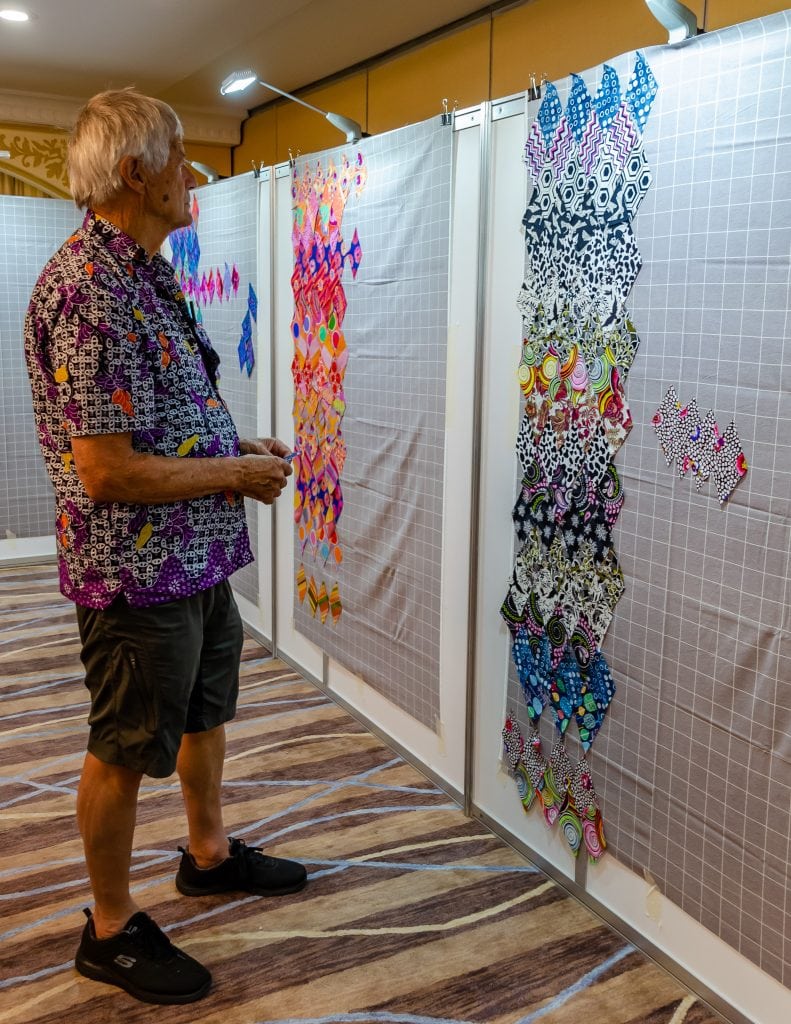

By the end of the class, everyone had a basic layout designed for their quilt that they were pleased with, though maybe not all the blocks were cut or put up. The walls of the room were a rainbow of colors and each quilt was a unique individual piece of art.


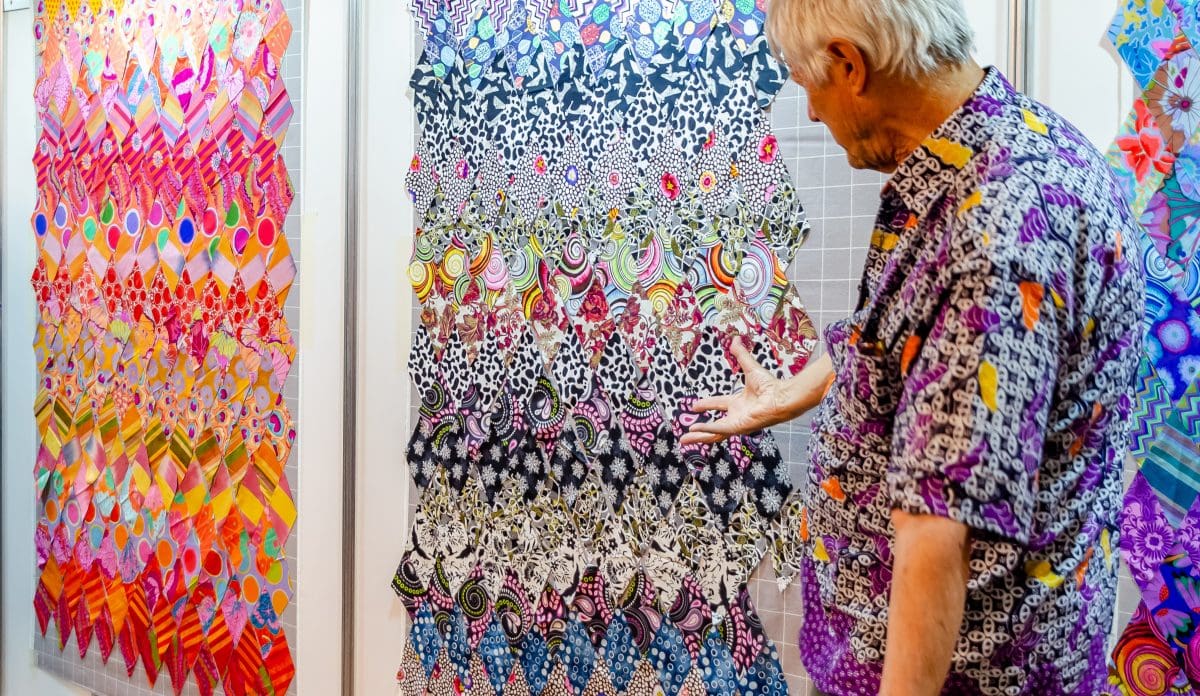
We finished with a show and tell as Kaffe and Brandon went around to each quilt and evaluated the final results. Here once again, Kaffe’s colourful vocabulary came out as he described with sincerity and passion what attracted him about each quilt. This final discourse was as much a critique as it was another lesson in the language and the concepts of Kaffe’s colour world.

He highlighted what he loved about each quilt using words that were also emphasised with large, expressive whole-body gestures. As he pointed out specific details about the colour combinations that he admired in each example, phrases like “love the chanciness”, “otherworldly palette”, “sings out” and “absorbs heat” were combined with positive encouragements like “gorgeous”, “stunning”, “outrageous”, “lush” and “delicate”. You could see each student glow with joy as he praised their colour innovations.
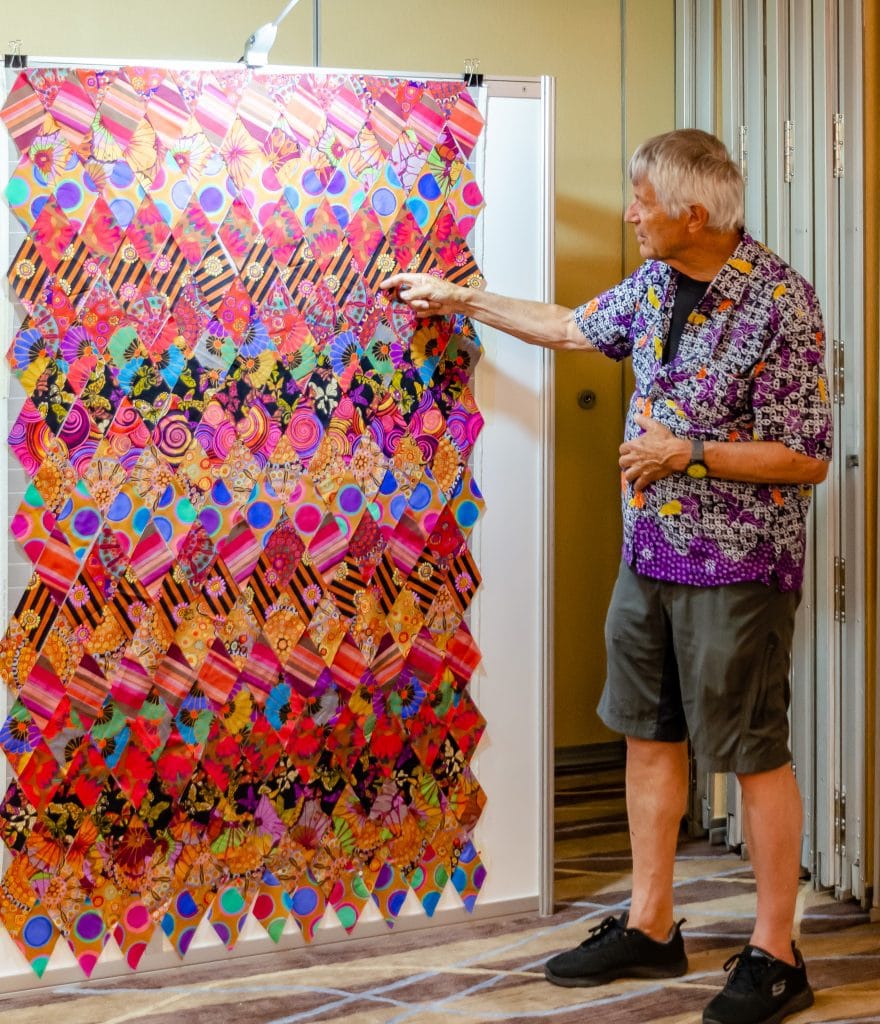
At the end, we all rolled up our designs inside the felt design wall without ruining the layout. Now all that was left was to sew it all together and then quilt it. This would forever be a tangible reminder of the day we spent with the design genius for whom “colour was like breathing”.
Information on Kaffe Fassett’s next workshop is on his website at http://www.kaffefassett.com/.
Besides this quilting class, I have also taken and written about quilt classes with Empty Spools, as well as the Judy Niemeyer Quiltworx class that I took at her retreat house in Montana.
Other quilting-related posts:
Spice up your quilt back with these ideas: 19 Ideas for a Unique Pieced Quilt Back
A list of the best quilting classes and retreats: My Wish List of Unique Quilting Classes, Quilting Workshops, Quilting Retreats and Quilting Holidays
A comprehensive list of where to donate quilts: Be a Quilt Volunteer – Where to Donate Quilts to Charity
An easy, free Quilt Block of the Month project: Triangle Fourplay – An Easy Quilt Block of the Month
Learning paper piecing the Judy Niemeyer way: Learn Paper Piecing With Judy Niemeyer Classes as A Quiltworx Retreat in Kalispell, Montana
Thanks for visiting.
Rose
Pin it!
