About 20 minutes west of Park City, Utah is the Jordanelle State Park. The park sits on the shores of a reservoir formed from the damming of the Provo River. While there were no open facilities in winter, the roads in the park were plowed and made for a pleasant drive to take in the surrounding scenery.
Photo location: A close up of the larger than life monument of Dr. Martin Luther King Jr in Washington DC. Just around the corner from the FDR Memorial, this is one of my favorite sections along the Tidal Basin. Winter is a great time of year to visit because there are no crowds.
Once again this year, the North American Travel Journalists Association (NATJA) has recognized my work on this website in their annual awards competition.
Last year, in 2017, my new website received a bronze and three Finalist recognitions. This year, the 2018 competition recognized my work in eight different categories, rewarding both my writing and photography. I am honored to be in the company of winning journalists, writers and photographers from publications such as National Geographic Traveler, The New York Times, and the Washington Post, as well as many seasoned travel bloggers.
The links to this year’s winning submissions are listed below.
Thank you NATJA for validating the quality of my work and for the continuing support. Thank you also to all those of you that keep coming back to read my stories and look at my photos.
2018 was an especially good year for travel. I was fortunate to be able to travel somewhere fun almost every month, both in the US and overseas.
Many of the locations that I visited were new to me, including a new continent-Africa. I also revisited some of my favorite cities-London, Istanbul and Washington D.C. I have written about my experiences for many of these destinations-but some are still sitting in my draft que, waiting to be finished (one of the resolutions for 2019 before I start traveling again).
Project 70,273 is one amazing woman’s goal to remember with quilts all of those disabled victims murdered by the Nazis between Jan. 1940 and Aug. 1941.
X marks the spot. On a treasure map, a large X means potentially good things in the form of gold coins or jewels. On a contract, X indicates where you sign your name, which makes the requirements on that piece of paper legally binding. For the Nazis in WWII, two red X’s on a disabled patient’s medical form meant death.
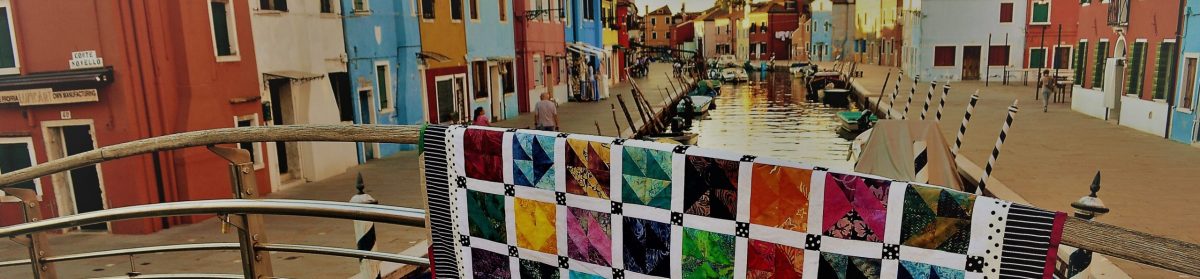
Like my treasured Christmas ornaments, my Christmas quilt comes out once a year. When it finally hangs on my family room wall, then I know that the Christmas season has finally begun. And like many of my quilts, I made the back interesting so that I can display it also.
If you have only one day in Marrakesh, I highly recommend a visit to the Majorelle Garden. This is one of the most visited tourist sites in the city – and for good reason. Amid the calm green oasis, pops of color provide a jolt to the senses. Yet the shades of yellow, teal and royal blue all harmonize with the hundreds of shades of green in such a way that you can’t imagine one without the other.
The Majorelle Garden in Marrakesh was created by French artist Jacques Majorelle in the 1920’s. The garden’s is famous today though because it was purchased and restored by Yves Saint-Laurent in the 1980’s. Regardless of of its high profile owner, the garden is a visual treat. Cobalt blue accents are a punctuation of color amid the green and silver foliage. That particular shade of blue was developed and patented by Jacques Maorelle and is named after him – Majorelle blue.
The El Badi Palace in Marrakesh, Morocco was built in the late 16th century by Sultan Ahmad Al-Mansur and was supposedly built and decorated with the most expensive materials of its time. The complex is believed to have had as many as 360 rooms built around a large central courtyard that contained a large pool. Subsequent rulers from other dynasties later stripped the palace of all its grandeur, so that today it sits as a romantic looking ruin that is home to storks and tourists.
An unexpected sight in Marrakesh, Morocco are the resident storks that nest on the high walls of the ruins of Badi Palace. They seemed completely unperturbed by the many tourists milling about below them.