
Last Updated on 02/20/26 by Rose Palmer
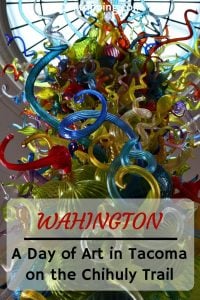
Most visitors to Seattle, Washington, who want to see works by master glass artist Dale Chihuly would most likely visit the Chihuly Gardens at the base of the Space Needle. But just 30 minutes to the south in Tacoma, Washington, you can also see a diverse series of his permanent art glass installations set in a variety of very distinct environments.

This story won Finalist – Destination Travel, Online Publication category in the 2017 North America Travel Journalists Association competition.
Finding Chihuly in Tacoma
I love the work of master glass artist Dale Chihuly. His pieces are big, bold, bright, colorful, and his huge installations seem to defy gravity. So when I recently had a free day in the Seattle area, I chose to go south to Tacoma and explore the Chihuly Walking Tour.
A native of Tacoma, Chihuly has used his international prominence to help revitalize the downtown area. By donating numerous pieces for permanent installations and helping to develop the Tacoma Museum of Glass and the connecting Bridge of Glass, Chihuly has turned Tacoma into an art glass destination.
The Chihuly Walking Tour
To follow all the stops in the Chihuly Walking Tour, I downloaded the STQRY app on my mobile device. This is a storytelling app that gave me all the information I needed to follow the Chihuly trail in Tacoma. The app had a map with all the locations of the Chihuly pieces throughout the Tacoma Museum District, as well as stories I could listen to for all the stops on the tour.
Tacoma Art Museum (TAM)

I started my Chihuly Walking Tour at the Tacoma Art Museum, whose comprehensive collection of Chihuly art glass spans most of the phases of his career, which started in the 1970’s. In the gallery where his many pieces are on display, there was also a fascinating video that describes how he developed and installed his various large exhibitions throughout his career, and also showed how he and his team go about making the very large glass pieces.
His first big exhibition was Chihuly Over Venice in 1996, the historical home of art glass, and also where Chihuly studied his craft and learned the team approach to glass blowing. Since then, he has done numerous installations annually all over the globe, including Jerusalem, London, and many large public gardens throughout the US.

The most interesting Chihuly display at TAM was Ma Chihuly’s Floats, which showcases 39 glass spheres of various sizes displayed on a stone wave sculpture created by artist Richard Rhodes. The floats were inspired by Japanese glass fishing floats and were donated to the museum by Chihuly as a tribute to his mother. The many colorful spheres of glass are ingeniously displayed – when I looked at them from certain directions, it looked like the waves and the balls went on forever.

Union Station


My next stop on the Chihuly trail was the distinctive Union Station, about a block south of the Tacoma Art Museum. This Beaux Arts-style building was built in 1911 during the height of train travel in the US, but it has now been converted into a courthouse. This building, as well as the seven blocks around it are on the list of the National Registry of Historic Places in the US.


Complementing the beautiful outside architecture and copper dome are five large art glass installations in the lobby, all donated by Chihuly. Hanging from the 90-foot-high glass dome as if it were floating in the air is one of Chihuly’s distinctive, colorful End-of-the-Day chandeliers.
In each of the half-circle arches on the second floor were four other unique installations. One wall is the Basket Drawing Wall, which displayed the paintings that were the start of the creative process Dale used to make his glass baskets series. On the Opposite wall was the Lakawanna Ikebana, a very large circular metal frame displaying a collection of glass flowers and intertwined vines.


In the arch window over the entrance door was the red Reeds installation. Some of the red glass reeds are more opaque, and some are more translucent, thus reflecting different amounts of light. The wood log holding the reeds came from the Tacoma area.


But the piece that slams your visual perceptions when you walk into Union Station is The Monarch Window, located across from the entrance doors. The orange glass set against the blue sky on a black grid frame is stunning. These pieces are part of Chihuly’s Persian series, and got the name Monarch because when the building vibrates from passing trains, the orange reflections on the floor flutter, making it look like monarch butterflies.


All of Chihuly’s pieces added so much to the setting at Union Station that it would be hard to imagine the lobby without them – but then I guess that was the point.

Chihuly Bridge of Glass

Next to Union Station was the Chihuly Bridge of Glass, which took me to the Tacoma Museum of Glass. The bridge had three more Chihuly installations. First, I walked under the multicolored Seaform Pavilion with thousands of pieces of art glass that include examples from many of his series.

The tunnel of the Seaform Pavilion opened up onto the Crystal Towers, which Chihuly specifically designed to act as a gateway and beacon of light to the city of Tacoma.


The final installation on the bridge was the Venetian wall, which, in Chihuly’s words, “were placed as if the pieces were a block in a quilt”. The special pieces in this wall represent 14 years of experimentation and innovative glassblowing on Chihuly’s part. The wall is lit by natural sunlight during the day and fiber optics at night, which gives it a completely different look.

Tacoma Museum of Glass

Once I crossed the Bridge of Glass, I reached a very interesting, large upside-down metal cone structure, which was the auditorium and hot shop for the Tacoma Museum of Glass. Inside the museum were many galleries showcasing works by various glass artists. But the most fascinating centerpiece was the hot shop where I watched a resident artist and his/her teams create intricate works of glass art.

Watching the teams of glass blowers working together to make the resident artist’s concept pieces was like watching a choreographed ballet. Each member seemed to have designated tasks and roles that changed as the pieces developed.
Rods went into furnaces to pick up molten glass or into “glory holes” to reheat the glass to keep it hot enough to work with. The glass was rolled, blown, pulled, patted, stretched, and shaped until it finally reached the shape imagined by the artist.
I kept holding my breath, expecting at any moment to see them run into each other with the long hot rods, but each person seemed to know their roles and place in the dance. The process of making the final product took a very long time as each piece was manipulated by the teams before they were attached together.


The museum also had a very ingenious program to get kids under the age of 12 involved in the glass design process. Children submitted drawings of their ideas, and each month the museum’s resident Hot Shop Team picked a design and turned it into glass.
The winning child artist gets to sit in the front row of the auditorium to watch their creation being made, which they then get to take home. Some of these child-designed pieces were on display in the museum, and they were very creative and looked quite challenging to implement.

University of Washington at Tacoma, Snoqualmie Library
I could have watched the hot shop artists all day, but I had to move on to the next stop on the Chihuly trail. I crossed back over the Bridge of Glass and headed uphill to the Snoqualmie Library at the University of Washington at Tacoma. In the second-floor student reading room inside the tower, suspended over an octagonal conference table, was the Chinook Red Chandelier.
This impressive sculpture is made up of over 900 individual glass pieces, is 19 feet tall, and weighs 1500 pounds. It uses different shades of red glass, which is coated with gold or silver, so that it shimmers like a beacon, especially when lit up at night. What an inspiring environment for learning and creativity.


The Swiss Restaurant and Pub

From the Library, I kept walking uphill to the edge of the university campus to the Swiss Restaurant and Bar. Not only was this a great place for a meal, but they also had a collection of eight Chihuly Venetian pieces on display above the bar.
Dale and his team would eat lunch at The Swiss when they were putting in the installations at Union Station, and they offered to display pieces in the pub at the end of that project.
Apparently, Dale Chihuly likes to collect all sorts of things, and The Swiss also had a collection of some of his accordions. After all that walking, it felt great to sit, relax, enjoy a great meal and a drink, and take in the eclectic environment of the pub.


I really enjoyed my day discovering the Chihuly Trail in Tacoma. It was an inspiration in color, shape, and light. It was also enlightening to see how one man’s success as an artist and his philanthropic projects could be so beneficial in revitalizing a community and turn it into a desirable travel destination.
Once I completed the Chihuly Trail in Tacoma, I also took time to visit the Chihuly Garden and Glass, located at the base of the Space Needle in downtown Seattle. I went near dusk and was able to appreciate the exhibits during daylight hours as well as lit up at night, which was a completely different experience.
I always look for works by Dale Chihuly when I travel.
Other Dale Chihuly stories:
Chihuly in New York City: East Meets West: Photos of a Dale Chihuly Exhibit at the New York Botanical Gardens
Chihuly at London’s Kew Gardens: A Date With a Chihuly Glass Exhibit at Kew Gardens
My chihuly inspired quilt: In Chihuly’s Garden
Enjoy, and thanks for visiting.
Rose
Pin this!